
Stop Using AI Like a Search Engine. Start Delegating Like You Would to a Real Employee.
I wake up most mornings without a perfect plan.
Sometimes I check what my human team is saying first. Other times I wake up from a dream with an idea and go straight to ChatGPT because it's not distracted by its own agenda. It's a blank slate ready to work through whatever I need right then.
That split—virtual actions go to AI, physical actions go to humans—has become my default operating system.
But here's what most entrepreneurs miss: the shift from "AI as tool" to "AI as teammate" isn't about better prompts or fancier software. It's about changing how you think about delegation itself.
The 10% Who Actually See Results
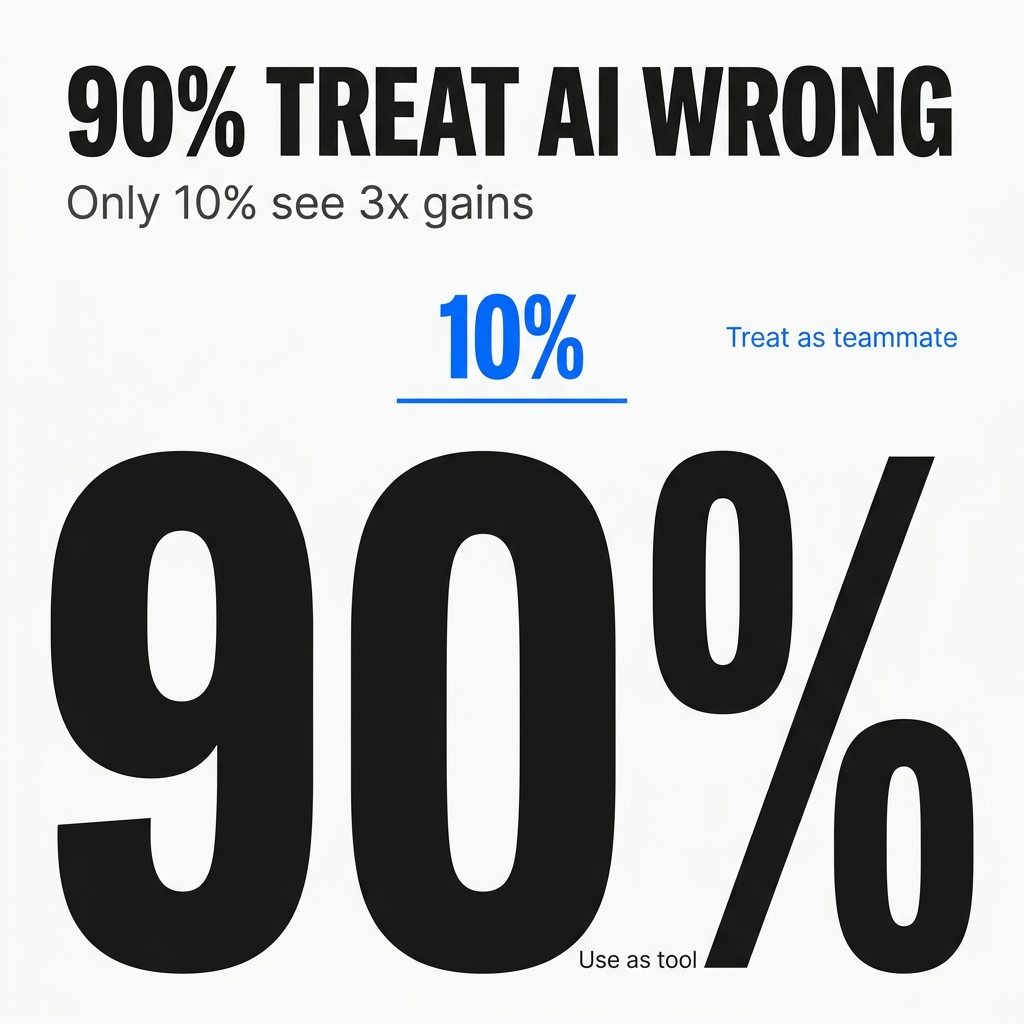
Research from Stanford University reveals something critical: while AI has the potential to dramatically boost productivity, less than 10% of professionals see significant gains.
The difference?
Underperformers treat AI like a tool. Outperformers treat it like a teammate.
Those who make this mental shift see empirical gains of 25% faster work, 12% more output, and 40% higher quality results. That's not incremental improvement. That's a fundamental change in how work gets done.
I've seen this firsthand. Before AI, I was stuck working with one client at a time as a solopreneur. The bottleneck wasn't talent or time—it was capacity. I couldn't record, analyze, and manage relationships for multiple clients simultaneously.
Now? We're working with partners. We've brought on a couple people. We outsource to contractors. AI didn't just save time. It unlocked the possibility of scaling up from solopreneurship to entrepreneurship.
What "Treating AI Like a Teammate" Actually Means
Here's what it doesn't mean: having some perfectly automated workflow where AI handles everything seamlessly.
That's not real.
What it does mean: you stop asking AI for answers and start delegating outcomes.
When you delegate to a human employee, you don't say "write me a blog post." You say "we need to reach small business owners struggling with cash flow—create something that addresses their biggest pain point and positions our tool as the solution."
Same with AI.
A Harvard Business School field experiment studying 791 professionals at Procter & Gamble found that AI functions as a "cybernetic teammate," delivering the same benefits as human collaborators. Ideas ranking in the top 10% were three times more likely to come from teams using AI as a teammate versus individuals working without AI.
Critically, teams that treated AI as a collaborator produced higher-quality solutions than individuals using AI as just a tool.
The Real Workflow: Virtual vs. Physical
My mental split is simple:
Virtual actions go to AI. Physical actions go to humans.
If I need something done in the digital world—content repurposing, SEO copywriting, email sequences—AI handles it. If it requires physical execution or someone else's control, I go to my human team.
Here's what that looks like in practice:
Pre-production: We schedule using Google Workspace Gemini. The AI manages overall organization and reduces steps in the planning process.
Production: We record in Riverside. AI enhances audio and generates transcripts automatically.
Post-production: We pass the edited video to Opus, which clips content and assigns viral scores. The transcript feeds into ChatGPT or Gemini for SEO, blogs, newsletters—the entire written ecosystem.
Before this setup, we'd use Zoom for calls, OBS for screen capture, manual scheduling, and cobble together workflows that ate hours every week. Now we've got partners who've built agentic workflows right into their tools.
The result? We turn around content in two to three business days instead of a week or more.
According to Atlassian's AI Collaboration Index, people who treat AI as a partner report 33% more productivity and save about 105 minutes every day—more than an extra workday each week.
That's not hype. That's what happens when you delegate outcomes instead of asking for outputs.
The Part Nobody Talks About: You Still Have to Press Start
Here's the reality that gets glossed over in most AI content:
You still have to initiate everything.
AI doesn't wake up, look at your calendar, and say "Hey, it's time to repurpose that podcast" or "We need to send out that newsletter today."
You're still the project manager. You're still the one kicking things off.
There's no exact science to this. I don't wake up at 4am with a perfect routine. I don't go to bed at 9pm and wake up at 9am consistently. Some mornings I check my human team first. Other mornings I go straight to AI with an idea because it's immediately available and focused.
It's not performative. It's practical.
And sometimes the complexity means your human team has to supervise what the AI team does. Like when Opus clips something weird and Jack has to step in and fix it. Or when Trello emails the team because things drift off schedule.
AI doesn't reach out to humans on its own. It's a one-way street where humans are still the quality control layer.
When AI Fails (And It Will)
Here's a story that shows the stakes:
We had a guest on a podcast who'd just started their own company. The AI transcription misspelled the new company's name. When we searched for SEO context, the results referenced the company he used to work for—his competitor—not his new venture.
By the time we realized what happened, that wrong information had already been distributed. SEO, social posts, everything pointed to the competitor's brand instead of the guest's new company.
The worst part? The stuff hard-coded into the video—like the wrong company name baked into the graphics—couldn't be changed. That wrong reference stayed visible permanently.
The guest noticed. The host noticed. And the host grilled us hard.
We fixed everything that wasn't hard-coded and apologized for the rest. It stung. Especially when you're trying to prove your team can operate like a bigger agency.
That's the gap between AI efficiency and human oversight.
According to recent research, 90% of "super productive" workers report that AI creates more coordination work between team members, even as they save 20+ hours per week individually. Organizations haven't adapted to support the teammate model yet.
The workflows were built for slower, human-only teams. When AI-accelerated individuals produce 3x the output, bottlenecks appear everywhere.
The Agentic Shift: Multiple AI Instances Working Together
The real shift happens when you move from chatting with AI to building with it.
At the entry level, you're in a chat interface asking ChatGPT for restaurant recommendations or college research. That's consumer-level usage.
The agentic shift happens when you start building applications or websites without knowing how to code. You need AI to translate your natural language into coding language that accomplishes your goal.
That's when multiple AI instances start communicating with each other to accomplish a goal.
We're building front-end marketing and sales tools using builders like Lovable. We're running automations through Make.com that distribute content outward. We're managing repositories with GitHub and hosting with Google Cloud Run.
One developer described migrating an OpenGL app to WebGL using Claude Opus 4.5, completing the complex migration "in half a morning." He ran 6 AI agents in parallel—"like freaking horizontally scaling yourself"—while agents implemented features, he reviewed previous work and planned the next set.
His conclusion: "With Claude Opus 4.5, I can deliver more products and more features than ever before."
That's delegation to AI the way you'd delegate to a capable team member.
The $6 Trillion Opportunity
World Economic Forum research indicates that AI teammates could represent a $6 trillion global opportunity by 2030—twice the size of the estimated $3 trillion IT market.
This represents a fundamental shift to "collaborative intelligence" where AI adapts and learns to achieve shared objectives with people, enabling workers to perform as "superhumans" rather than simply getting faster at routine tasks.
But here's what that actually requires:
Organizational redesign.
Upwork Research Institute found that workers treating AI as a teammate report a 40% boost in productivity. But 88% of high-performing AI users experience burnout because organizations haven't adapted to support the teammate model.
The mindset shift has to happen at both individual and organizational levels to be sustainable.
What This Means for You
If you're still treating AI like a fancy search engine or writing assistant, you're leaving massive productivity gains on the table.
The shift to treating AI as a teammate starts with how you delegate:
Stop asking for outputs. Start delegating outcomes.
Virtual actions go to AI. Physical actions go to humans. And you're still the one pressing start every single day.
It's not perfect. It's not automated. And you'll still have moments where AI fails spectacularly and you have to manually fix the mess.
But when you make this shift—when you start delegating to AI the way you'd delegate to a capable employee—you unlock capacity you didn't have before.
That's how a 3-person team operates like a 15-person agency.
That's how you go from solopreneurship to entrepreneurship.
And that's how you save hundreds of hours every week while producing higher-quality work than you ever could manually.
The tools are already here. The question is whether you're ready to change how you think about delegation itself.

Comments
Post a Comment